For a long time, I measured a good day by what I had built. A system became faster. A difficult bug disappeared. A release went out without drama.
Engineering gave me a useful way to see the world: break a large problem into smaller ones, make the trade-offs explicit, and keep improving the system. Becoming a founder did not make that mindset less relevant. It made the system much larger.
Learning the engineering craft
At Zomato, I worked on systems where performance and reliability were not abstract qualities. Software had to respond quickly and keep working under real demand. That experience taught me to respect fundamentals: understand the constraints, measure what matters, and avoid cleverness that makes a system fragile.
Later, at PushOwl, I got closer to the Shopify ecosystem and to the people using what we built. The technical work still mattered, but it was only one part of the product. A well-designed system is not automatically a useful product. Usefulness comes from understanding the person on the other side of the screen.
PushOwl's acquisition by Brevo became a natural point of reflection. I had seen a product grow, a team evolve, and engineering decisions compound over time. The next question was not simply what I wanted to build. It was what kind of responsibility I wanted to take on.
The scope gets wider
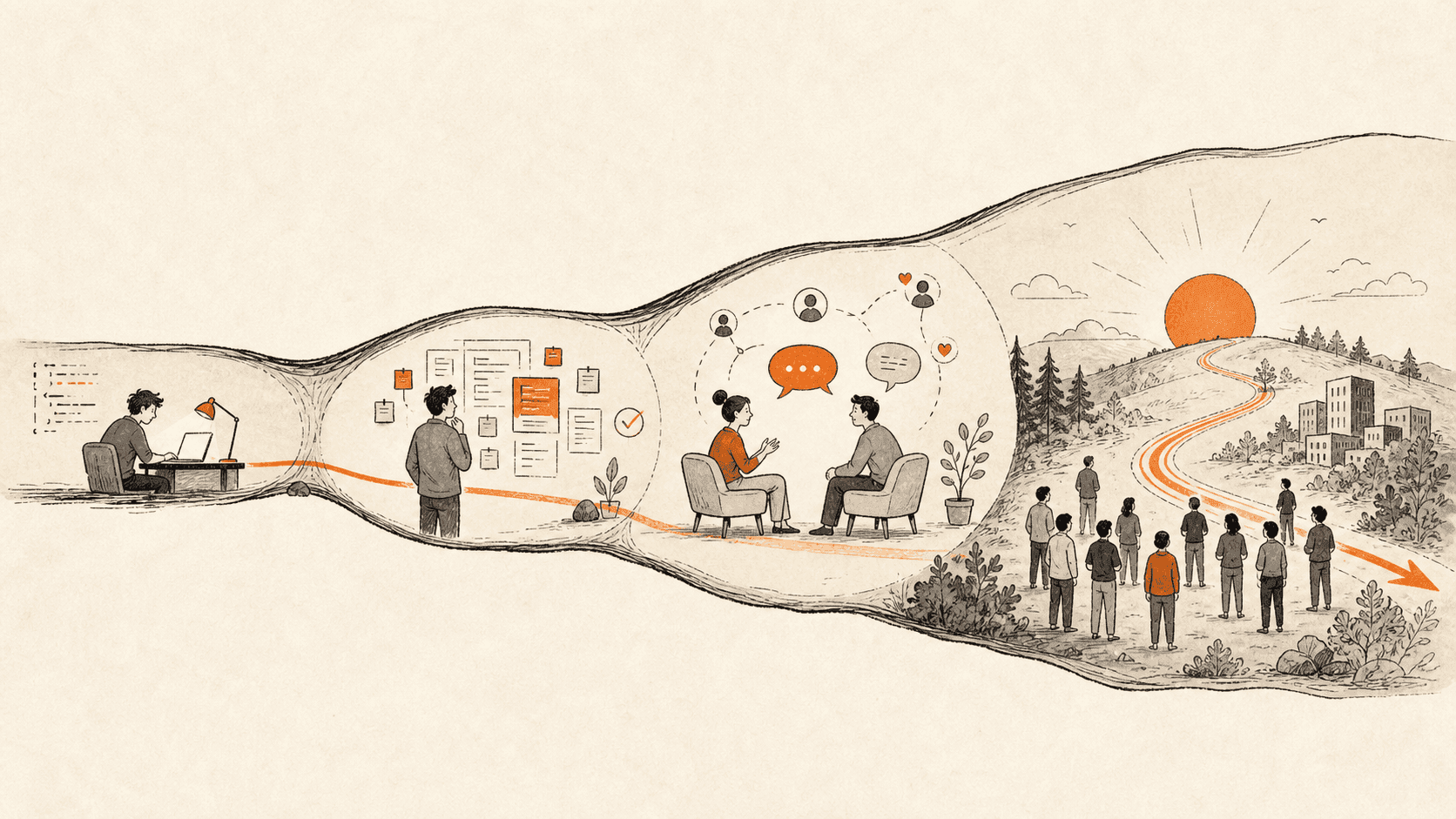
The transition from engineer to founder is sometimes described as a leap. For me, it felt more like a widening circle of ownership.
As an engineer, you might own the implementation. Then you begin to own the architecture, the quality of the release, and the way the team works. As a founder, the circle expands again:
- Is this a problem worth solving?
- Does the product make sense to a customer?
- Can people discover it and trust it?
- Can the business support the promises the product makes?
Code remains part of the answer, but it can no longer be the whole answer.
Building FoxSell
We started FoxSell around a clear, practical need: helping Shopify merchants create better buying experiences through product bundles. It was a problem close enough to understand, but deep enough to keep teaching us.
Building for merchants changes the way you think about quality. Reliability is not just an engineering metric when your product sits inside someone else's storefront. Simplicity is not just visual polish when the person configuring the product is also running a business.
Some of my engineering instincts transferred directly. Start with the real constraint. Reduce unnecessary complexity. Create feedback loops. Fix root causes. Others needed adjustment. A founder cannot wait for complete information, and not every important decision can be benchmarked.
What I had to unlearn
The hardest changes were not technical.
A correct solution is not the same as the right product. You can execute an idea perfectly and still miss the customer's actual need.
More capability does not always create more value. A smaller, clearer product often serves people better than a flexible one that asks too much of them.
Talking to customers is part of building. It is not a distraction from the work. It is how the work gets direction.
Progress is uneven. Engineering can offer the comfort of a closed ticket. Company-building has fewer clean edges. Some weeks are about shipping; others are about listening, revisiting assumptions, or creating the conditions for later progress.
Still an engineer, just at a different layer
I do not think of founding as graduating from engineering. I still care about how things work, why they fail, and whether they can be made simpler. The difference is that I now apply those questions to the product, the customer experience, and the company around the code.
That has been the most interesting part of the journey. The craft changes as the scope changes, but the underlying habit remains: stay curious, look closely at the problem, and keep building toward a better answer.
I am still early in that process. This blog is where I plan to document it honestly - the engineering lessons that continue to matter, the founder lessons I am learning in real time, and the space between the two.